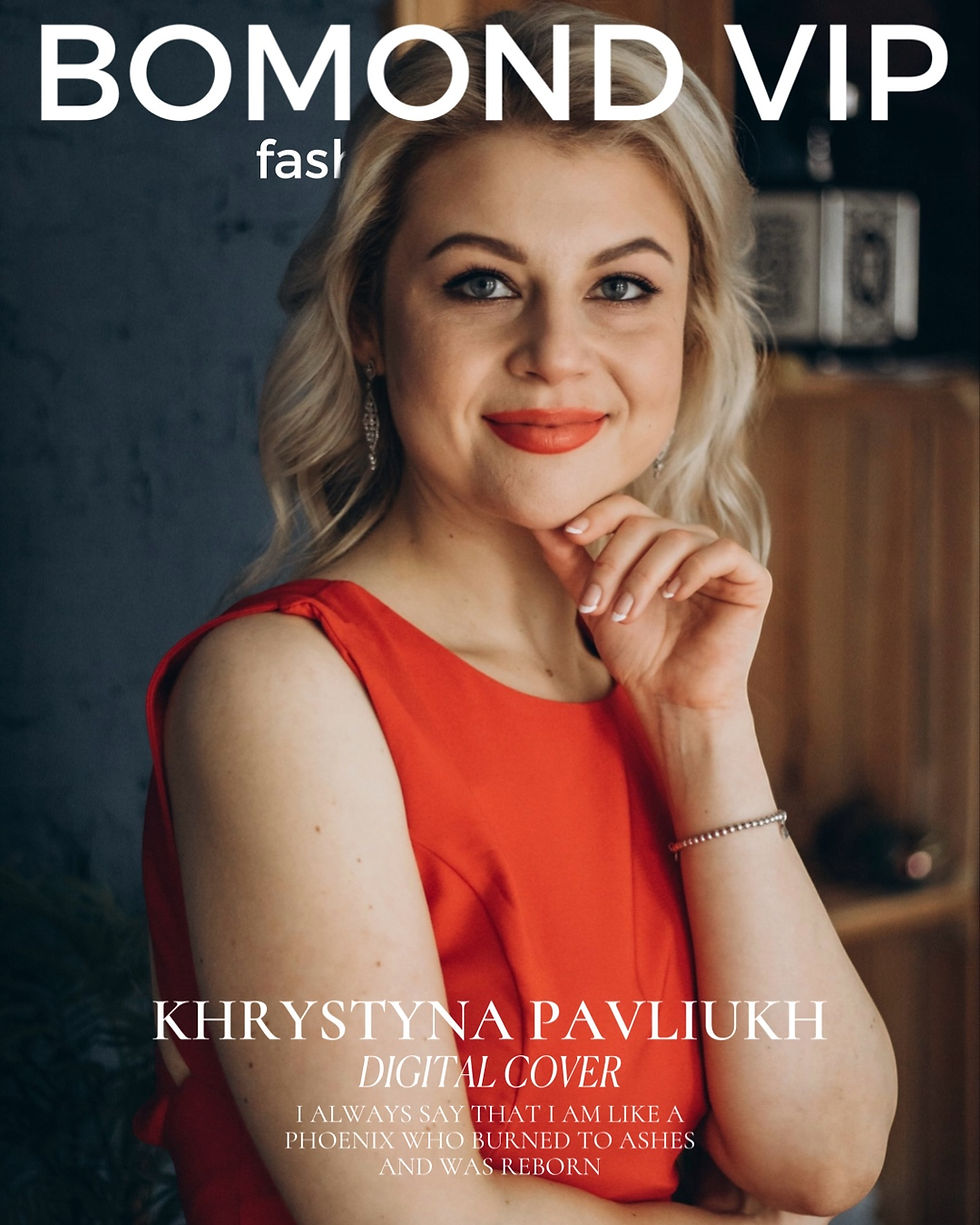
Katrin Kashurt: “Now or Never: The Courage to Create Your Own Reality”

Katrin Kashurt is a psychologist, women’s coach with 16 years of professional experience, and the creator of the “High-Value Feminine State” method, grounded in the analytical psychology of Carl Gustav Jung. The subject of BOMOND VIP’s digital cover works with women’s beliefs, inner states, and identities, exploring how a woman’s relationship with herself shapes her choices, personal boundaries, and quality of life.
A familiar life script can appear flawless on the outside while no longer reflecting the person one has become. Recognizing this disconnect is the first step. The next requires considerably more: reassessing one’s beliefs, letting go of the need to meet other people’s expectations, and accepting responsibility for decisions that change the established order of things.
In her interview with BOMOND VIP, Katrin Kashurt explores how inner stability is developed, why personal boundaries begin with an awareness of one’s own worth, and what allows women to move beyond fear and external expectations. She also introduces her forthcoming first English-language book, Now or Never, which explores the profound journey of coming home to yourself — rediscovering who you truly are beneath inherited beliefs, fears, and social roles. Bringing together psychology, scientific insights into the human brain, and personal experience, the book examines how our inner states shape our choices, how a new identity is formed, and why genuine transformation requires not only self-awareness but also conscious action.
Your life does not require someone else’s permission. It requires a decision for which you are prepared to take responsibility. This is the central idea running through the conversation with Katrin Kashurt, a woman who has built a successful life and career after immigrating to the United States and dedicated her professional mission to empowering women to discover their potential and create lives on their own terms.
And perhaps this is the most powerful message behind Now or Never: coming home to yourself is not about returning to who you once were. It is about finding the courage to become the person you consciously choose to be.

Ms. Katrin, relocating to the United States often means more than moving to another country; it also requires redefining one’s own possibilities and future. When familiar sources of stability disappear, it becomes clear what a person can truly rely on. What decision marked the beginning of a new life for you, and what were you no longer willing to carry forward from your past?
I believe that immigration is always about much more than moving to another country. It is a profound psychological challenge, often accompanied by the loss of a familiar identity and the need to create a new one. After all, it is not only the world around you that changes, but also the way you see yourself within that world.
At 24, I made the decision to move to the United States. That decision became the first step toward my new life. Living in America had always been my dream, yet turning that dream into reality marked the beginning of a challenging inner transformation. The first six months were emotionally difficult. My family remained in Ukraine, while I had to adapt to a new society and culture and find my place in an entirely unfamiliar environment.
But I had something that no one could take away from me — my mindset. More than a decade of playing chess at a competitive level had shaped a strong mindset: the ability to think strategically, make decisions in the face of uncertainty, and trust my own intuition.
I deeply resonate with Viktor Frankl’s insight that almost everything can be taken away from a person except the freedom to choose their attitude toward their circumstances. This is why I believe that developing our mindset is one of the most important investments we can make in ourselves. After all, the way we think largely determines how we perceive the world, which opportunities we recognize, and the decisions we make. I explore this connection between our inner state and the reality we create in greater depth in my book, Now or Never.
And if you ask me what I chose to leave behind, it was the belief that my future had to be defined by the circumstances of my past. I came to understand that our experiences shape us, but they do not have to limit what is possible for us. My past is part of my story, but it does not define the limits of my future.
That realization marked the beginning of true inner freedom for me: understanding that while we cannot always choose the circumstances we find ourselves in, we can choose who we become in response to them.

Over 16 years of psychological practice, you have worked with women whose lives have taken very different paths. Yet you have likely witnessed many instances in which a life that appears successful on the outside no longer brings inner fulfillment. What most often keeps a woman in a reality that no longer reflects who she is: fear of change, attachment to a familiar role, or an idea of who she is supposed to be?
What you are describing can be understood in psychology as an inner conflict. On one hand, a woman desires change; on the other, she is afraid of it. And what makes this particularly fascinating is that this contradiction is rooted not only in psychological beliefs but also in certain biological mechanisms.
Our brain does not always evaluate reality simply in terms of what is good or bad for us. Very often, it relies on another distinction: what is familiar and what is unfamiliar. What we have grown accustomed to — including our identity, behavioral patterns, beliefs, and even unsatisfying life circumstances — may feel more predictable and, therefore, subjectively safer. Even when, in reality, that sense of safety is far from justified.
Conversely, anything new, even when it represents something we genuinely desire — building a fulfilling relationship, getting married, expanding a business, or realizing our potential — can trigger anxiety. This is because uncertainty can sometimes activate our natural defensive response, commonly known as fight, flight, or freeze.
And this is where we encounter a fascinating paradox. One woman runs away from the very opportunities she has been dreaming of: postponing decisions and finding reasons not to act. Another freezes — remaining in the same place for years, even though, deep down, she feels ready for change. A third begins to fight: against herself, her circumstances, or the people closest to her, sometimes turning her pursuit of happiness into a constant inner battle.
And here is something essential to understand: Not everything that feels safe is necessarily good for us. And not everything that frightens us represents a real threat.
This is precisely why, in my work with women, I place particular emphasis on their beliefs, inner state, and identity. Because genuine transformation begins not only with taking new actions, but also with developing the ability to stop automatically perceiving the unfamiliar as dangerous.
And perhaps the most important question we can ask ourselves in such moments is: “Am I staying where I am because this is truly my choice, or because I am afraid of becoming the woman I genuinely want to be?”

You developed your own “High-Value Feminine State” method, drawing on the analytical psychology of Carl Gustav Jung. What does this concept mean in practical, everyday life? What decisions, personal boundaries, and attitudes toward herself distinguish a woman who is no longer willing to diminish her ambitions to meet other people’s expectations?
I believe that inner peace is the new luxury. And I am not talking about the absence of problems, emotions, or life’s challenges. I am talking about an inner state in which a woman is no longer held captive by external circumstances or her own automatic reactions.
In my practice, I integrate principles of Carl Gustav Jung’s analytical psychology, provocative approaches, coaching, and my own techniques. At the heart of my work are a woman’s inner state, her beliefs, unconscious behavioral patterns, and identity. Because simply understanding why we behave in a certain way is not enough. What truly matters is learning to choose a different response, make a different decision, and ultimately develop a new way of being ourselves.
This is where the concept of neuroplasticity becomes particularly fascinating — the brain’s ability to change in response to experience and learning. When we consistently work with our beliefs, emotional responses, and behaviors, we create the conditions for developing new patterns of thinking and responding. Over time, this can transform not only what we do, but also how we perceive who we are.
Let me give you a simple example. Imagine a woman who has become accustomed to agreeing to things that do not truly align with her, simply to avoid conflict or maintain someone else’s approval. Her automatic response is to say “yes,” even when everything inside her is saying “no.”
But as she develops inner stability, a space begins to emerge between an external trigger and her response — a space for conscious choice. And instead of repeating the same familiar pattern, she can calmly say “no,” without aggression, guilt, or the need to justify herself.
To me, this is what true inner luxury looks like. It is not about controlling the world around us, but about remaining connected to ourselves, even when that world is unpredictable.
A woman who embodies this state does not necessarily speak louder, demand more, or feel the need to prove anything to anyone. She simply no longer makes decisions solely out of fear, the need for approval, or habit. She learns to act from a place of inner calm, self-respect, and awareness of her own values.
Because a woman’s true strength does not lie in always having to be strong. It lies in having the inner freedom to choose what genuinely aligns with her desires, dreams, and goals.

We cannot choose every circumstance we face, but we can reconsider the decisions that shape our future. Where, in your view, lies the boundary between accepting reality and passively consenting to it? And how can a person recognize when it is time to change her circumstances rather than search for yet another explanation for why they remain unchanged?
I am fundamentally opposed to the idea of fighting against reality. Because resisting what is already happening often only intensifies our inner struggle and drains the energy we could otherwise direct toward meaningful change.
I believe that the path to inner peace begins with accepting reality as it is for us in the present moment. If I am in pain, I acknowledge that pain. If I feel joy, I allow myself to fully experience it. And if something in my life no longer brings me fulfillment, I do not try to convince myself otherwise.
This brings us to one of the most important principles of my philosophy — being honest with ourselves.
Before changing our lives, we need to ask ourselves a very simple yet profoundly important question: “Am I truly happy with the reality I am living in right now?”
Not according to society’s expectations, our family’s beliefs, or someone else’s definition of what is “right.” But according to our own feelings, values, and genuine desires.
It is from this place of honesty that a new strategy begins to emerge. What do I truly want? What is no longer working in my life? What can I influence? And what is the next step I am willing to take?
In my work with women, as well as in my book Now or Never, I place great emphasis on bringing together two states that may initially seem contradictory: acceptance and personal agency.
Acceptance is not surrendering to circumstances. It is choosing not to waste our energy denying what already exists. Personal agency, on the other hand, is recognizing our ability to influence what happens next.
To me, true inner freedom emerges at the intersection of these two states. It is the ability to say, “Yes, this is what my reality looks like today. I acknowledge it. But that does not mean it has to remain the same tomorrow.”
And this is precisely where the line between acceptance and passivity lies. Acceptance allows us to see reality clearly, without illusions, while conscious choice empowers us to begin changing it.
I do not allow my circumstances to define who I am. I choose how to respond to them and what I create next.

Fear of making mistakes, the need for approval, and the habit of placing other people’s expectations above one’s own desires can postpone the life a person truly wants for years. What step helps bridge the gap between recognizing the need for change and making a real decision to act?
I believe that high-quality psychotherapy is one of the most valuable tools for self-discovery. It helps us gain a deeper understanding of our true needs, values, personality traits, how our nervous system responds to stress, how our beliefs are formed, and why we repeatedly find ourselves following certain behavioral patterns. Most importantly, it creates an opportunity to gradually transform the inner beliefs that no longer align with the person we want to become.
But there is something without which, in my view, genuine transformation is impossible: radical honesty with ourselves.
We often believe that we are afraid of change. But sometimes, what frightens us most is the prospect of confronting our own feelings, acknowledging an uncomfortable truth, or making a choice that others may not approve of.
For example, a woman may avoid an important conversation for years because she fears conflict. She suppresses her emotions, convinces herself that the timing is not right, and continues living within the same familiar pattern. In the short term, avoidance brings relief. But in the long term, it can reinforce her fear and move her further away from the life she truly desires.
In my book, Now or Never, I explore the idea that awareness alone does not create change. Between understanding and a new reality, there must be action. And that action does not necessarily have to be dramatic. Sometimes, it is one honest conversation, one clearly established personal boundary, or one decision we are no longer willing to postpone.
We cannot always wait for fear to disappear. But we can learn to take action without allowing fear to make our decisions for us.
This is why I encourage women to begin not by asking, “How can I stop being afraid?” but by asking a different question: “What choice would I make today if I were guided not by fear, but by my own values?”
And then, to take at least one concrete step in that direction.
Because a new identity is shaped not only by what we come to understand about ourselves, but also by the decisions we begin to make and the actions that gradually become our new normal
Ultimately, life does not change the moment we stop being afraid. It changes the moment we stop allowing fear to define our future.

You are completing work on your first book. That is truly inspiring. What do you consider the central idea of this book, and what new perspective on her own life would you like a woman to take away after reading the final page?
The central idea of my book, Now or Never, is coming home to yourself. Returning to that part of who we are that often gets lost beneath other people’s expectations, deeply ingrained beliefs, fears, and social roles.
I believe that we do not simply perceive reality — we actively participate in creating it. Our thoughts, beliefs, emotions, physiological state, and the way we perceive the world influence the decisions we make, the actions we take, and ultimately, the lives we build.
In this book, I bring together psychology, scientific insights into how the brain works, and my own life experiences to explore a fundamental idea: transformation begins not only by changing our external circumstances, but, more importantly, by transforming our inner patterns. When we begin to recognize what drives our reactions and choices, we create the opportunity to gradually develop a new identity — one that aligns with our true values, desires, and potential.
But it was essential to me that this book would be more than just an intellectual experience. I want it to inspire action. I want readers to reach the final page not only with a deeper understanding of themselves, but also with the courage to make a choice they may have been postponing for years. And here lies a profound paradox: Coming home to yourself does not mean returning to who you used to be. It means finally allowing yourself to become the person you consciously choose to be.
That is precisely why the book is called Now or Never. We can spend our entire lives waiting for the perfect moment to begin truly living. But that moment may never arrive on its own.
And if there is one question I want to remain in a reader’s heart after turning the final page, it is this: “Are you ready to finally come home to yourself? Because the time is now or never.
Your commitment to helping women unlock their potential and become the leading ladies of their own lives is invaluable. What should a woman stop waiting for from her circumstances, the people closest to her, or even herself, so that she can finally begin acting in accordance with her own desires and potential?
First and foremost, I would encourage women to stop waiting altogether. Waiting for the perfect moment, for someone else’s approval, for certain circumstances to fall into place, or even for that future version of themselves who will finally feel ready, confident, or successful enough to allow themselves to enjoy life.
I believe that one of the most valuable skills a modern woman can develop is the ability to relax, find pleasure in who she is, enjoy her life, and truly embrace the experience of living it. Not someday, when everything finally falls into place, but right now.
After all, the more we attach our happiness to specific expectations, the greater the risk of disappointment when reality does not unfold the way we imagined. And without even realizing it, we can turn our lives into an endless pursuit of the next achievement.
In my work, I often draw women’s attention to the difference between two inner states: chasing and receiving. The first is a constant pursuit — chasing, earning, proving ourselves, and striving to obtain something. The second is a state of inner openness to life: the ability to recognize opportunities, receive the good that comes our way, enjoy the process, and still remain an active participant in shaping our own reality.
And here, I want to emphasize something important: I am not advocating passivity. Quite the opposite. I deeply believe in the power of conscious action. But what matters is not only what we do, but also the inner state from which we act.
When a woman stops living in a constant state of anticipation and tension, when she allows herself to experience happiness today, her relationship with herself, with others, and with the opportunities around her begins to change. She becomes more open, authentic, and confident.
And from this state emerges a special kind of magnetism — not as an attempt to attract approval or impress others, but as a natural expression of inner harmony. She almost becomes a magnet for new connections, ideas, and opportunities, because she begins to notice what she might previously have overlooked while focusing solely on the outcome she wanted to achieve.
To me, true feminine strength lies in the ability to combine ambition with ease, determination with inner peace, and the desire for more with genuine appreciation for what is already present.
You do not have to postpone your happiness until all your dreams come true. Learn to enjoy your life while you are making them happen.
Because life is not only about what we achieve. It is also about how we feel along the way toward our dreams.

“Now or Never” is a formula that leaves little room for endless postponement. How do you envision the next chapter of your life and professional mission? Which ideas do you want to turn into tangible projects so that your method, your book, and your experience can help more women create lives on their own terms?
You know, one of the most important parts of my mission is to remind every woman of one simple yet profoundly important truth: “There is nothing wrong with you. You do not have to become someone else to be worthy of love, happiness, or the life you dream of.” Even if you do not meet other people’s expectations. Even if your path looks different from what society considers conventional. Even if, somewhere along the way, you were made to believe that something about you was not right.
I want women to stop spending their lives trying to earn the right to be themselves.
And it is around this philosophy that I envision the next chapter of my professional mission.
My book, Now or Never, is only the beginning. I dream of building an entire ecosystem of knowledge, educational programs, international initiatives, and communities. I also want to train a new generation of professionals who can carry this approach forward, helping tens of thousands of women discover their potential, develop a new identity, and create lives that genuinely reflect who they are.
But my greatest dream goes beyond helping women achieve more.
I want women to bring more peace, harmony, beauty, love, and freedom into the world through their inner state of being. Because when one person’s inner world transforms, that transformation naturally extends into their relationships, their families, and the people around them.
And this is how I believe meaningful change begins — through individual transformations that may seem small from the outside but are profound enough to touch countless lives.
Sometimes, a very special vision of my future comes to me.
I am 96 years old.
I can feel that my journey on this Earth is slowly coming to an end. There is a certain sadness in knowing that one day I will have to say goodbye to this beautiful life. And yet, at the same time, my soul is filled with an extraordinary sense of peace.
I am preparing to present another one of my books. Perhaps my last.
I am getting ready for one final meeting with the people for whom I have spent my life writing, working, learning, and creating.
And then, I walk onto the stage.
Before me is an enormous auditorium. Thousands of people.
I look into their eyes. I feel their energy.
And suddenly, I know.
It was all worth it.
Every challenge. Every risk. Every decision. Every moment when I chose to move forward, even without knowing what was waiting for me on the other side.
And perhaps the greatest achievement of my life will not be the books I have written, the projects I have created, or even the number of people I have reached.
It will be knowing that, somewhere along the way, because of my work, someone finally believed in herself.
Someone found the courage to begin again.
Someone stopped being afraid to be who she truly was.
And someone, perhaps for the very first time, gave herself permission to be happy.
If one day I can look back on my life with that feeling, I will know that I have lived it with purpose.
That is the legacy I want to leave behind.
Not merely books or methods, but a philosophy of life that will continue to live through other people long after I am gone.
And do you know what matters most?
I do not have to wait until I am 96 to experience the meaning of this journey.
I can feel it already. Today.
Because the life we dream of does not begin someday in the future. It begins the moment we finally find the courage to choose ourselves.
And if these words reach a woman who is still waiting for permission to begin living life on her own terms, there is something I want her to know:
“You do not have to wait any longer.
You already have the right to be yourself.
You already have the right to be happy.
And your life is not something that will begin someday. It is happening right now.
So, if not now, when?
If not you, who?
The time is now or never.”
INSTAGRAM @blog_kashurt